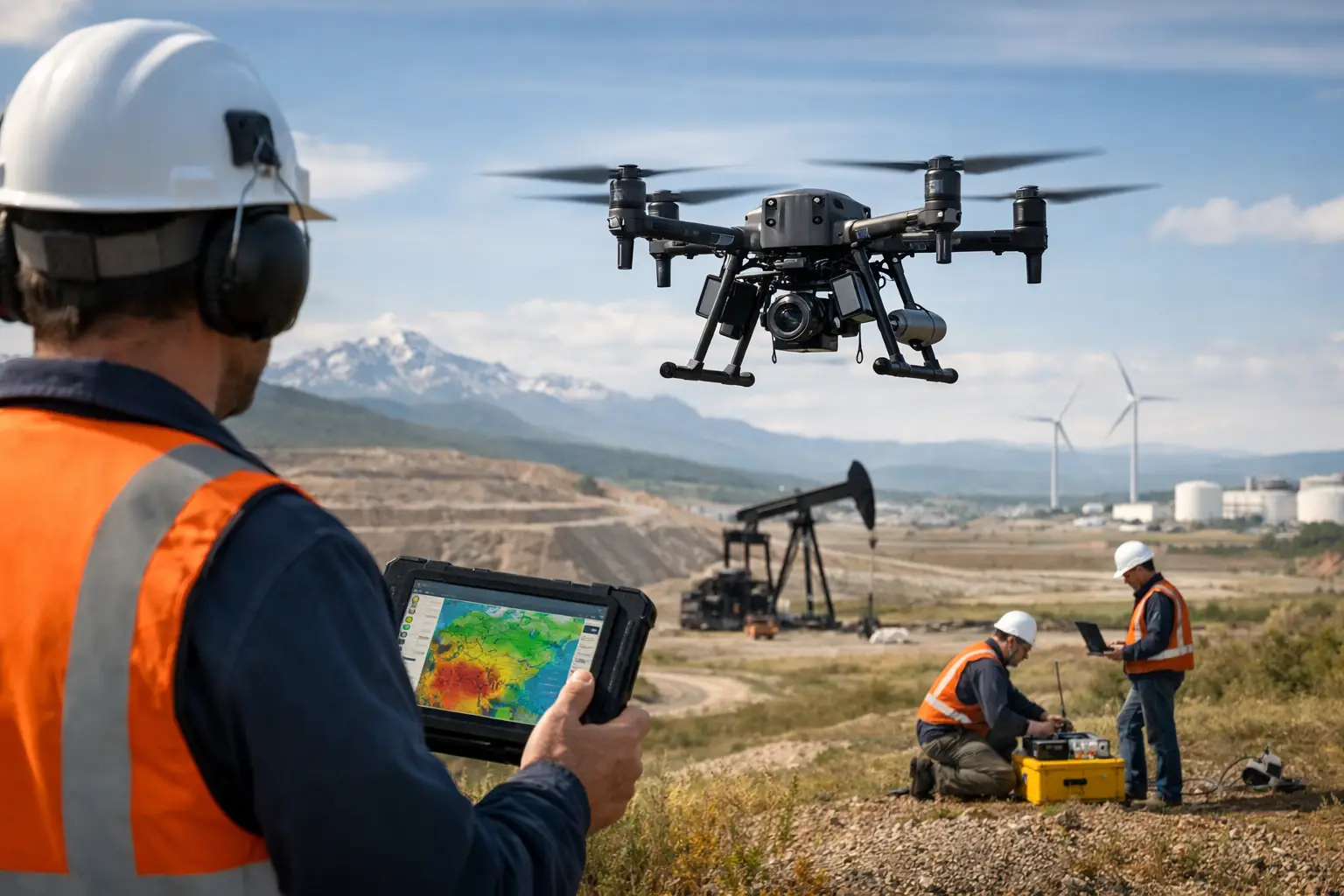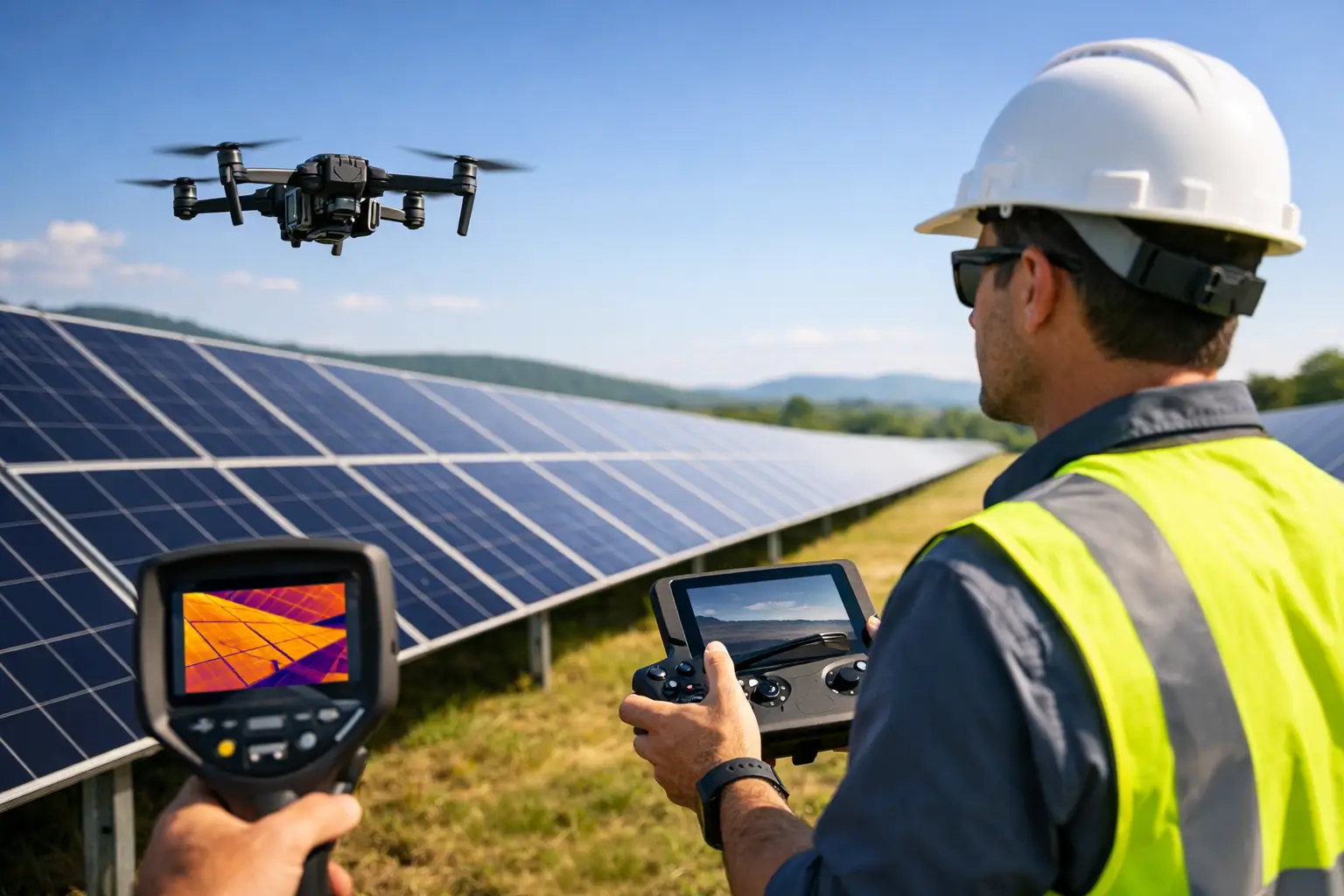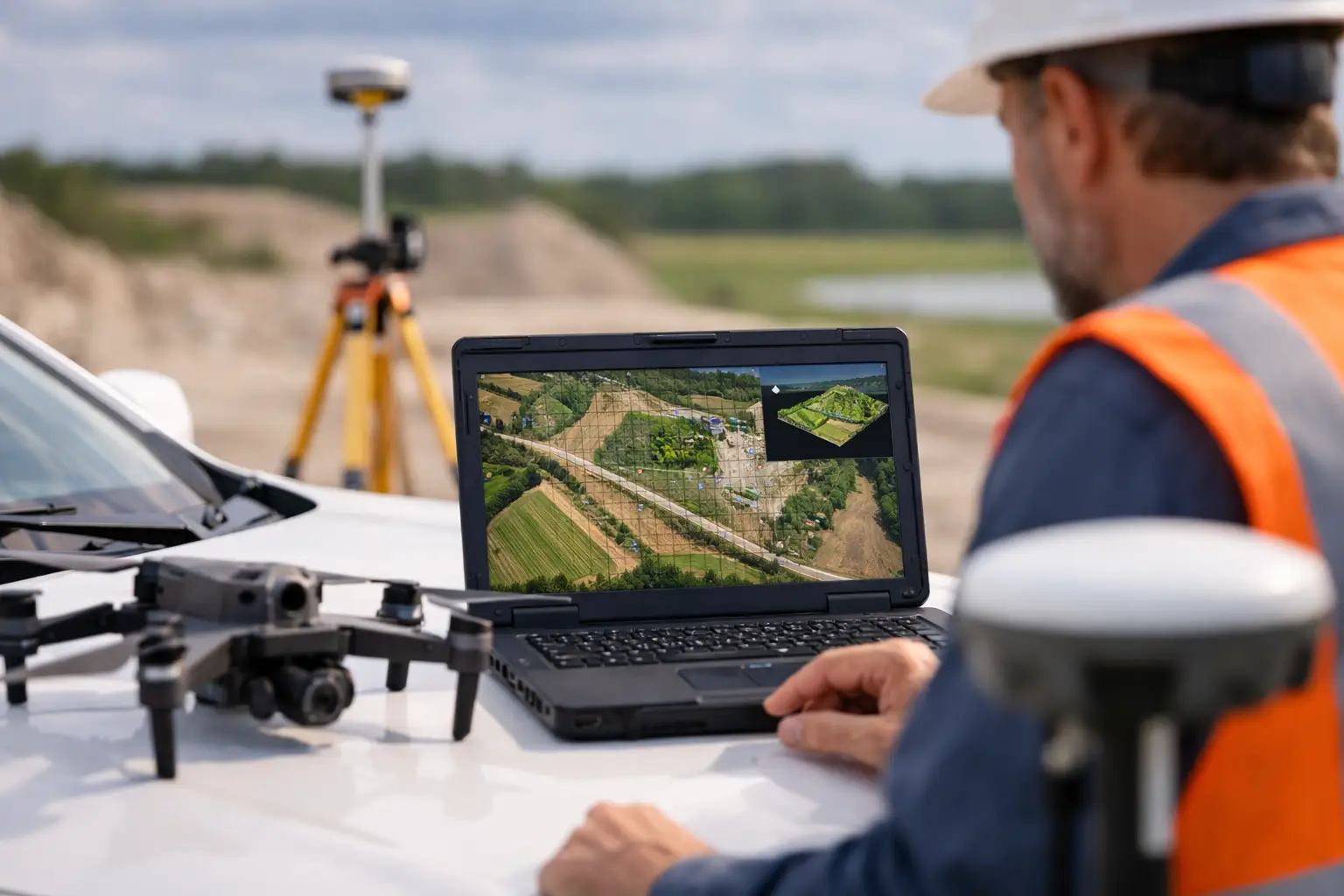
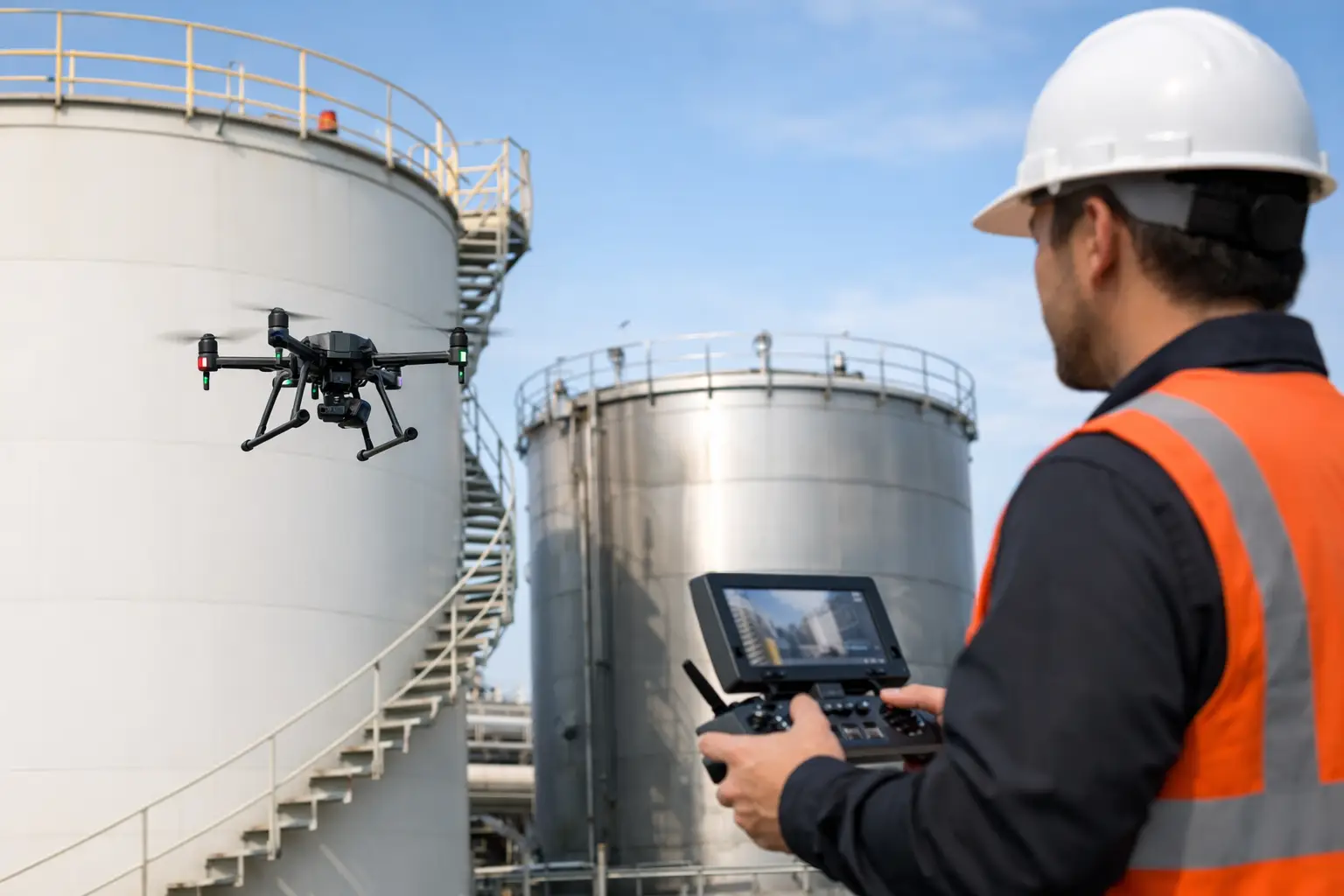
A tank outage can place personnel at height, near hazardous atmospheres, or inside a confined space where every hour of access affects production. Knowing how to inspect tanks with drones is therefore not simply a question of putting a camera in the air. It is an engineered inspection workflow that combines asset knowledge, flight control, calibrated sensing, and a reporting chain that maintenance and integrity teams can defend.
For industrial operators, the strongest use case is not replacing every close-up examination. It is reducing unnecessary entry, accelerating condition screening, and directing rope-access, NDT, or repair crews precisely to the locations that require intervention.
How to Inspect Tanks With Drones: Start With the Inspection Objective
Tank inspection begins with a defined decision, not a selected drone. The inspection team must establish whether the assignment concerns coating degradation, shell distortion, roof drainage, weld condition, corrosion indicators, seal integrity, nozzle condition, structural attachments, or internal cleanliness and damage.
External storage tanks, elevated water tanks, process vessels, and enclosed tanks each create different flight and sensing constraints. An external inspection may need high-resolution visual coverage of shell plates, roof penetrations, ladders, platforms, and pipe connections. An internal inspection may require a confined-space aircraft with collision tolerance, obstacle sensing, stable low-light imaging, and a pilot workflow designed for GPS-denied operation.
The required output should be agreed before mobilization. A useful deliverable may include georeferenced or asset-referenced image records, annotated defect registers, roof and shell orthomosaics where geometry permits, 3D photogrammetric models, thermal observations, and a prioritized action list. Raw footage alone rarely supports a defensible maintenance decision.
Establish Safe Operating Conditions Before Flight
A drone does not remove process risk. It changes the exposure profile and must be integrated into the site permit-to-work system, isolation plan, and safety controls. Before deployment, the operator should confirm tank status, access restrictions, adjacent operations, electromagnetic interference sources, wind exposure, and the presence of hazardous materials.
For internal tank work, atmospheric testing and ventilation requirements remain the responsibility of the site safety system. The aircraft, lighting equipment, batteries, and communications method must be appropriate for the classified or non-classified environment. A standard commercial drone should never be assumed suitable for a flammable-vapor environment. If hazardous-area conditions exist, the inspection method must be reviewed against the applicable site classification and equipment requirements.
External flights require equally disciplined controls. A rotating roof, active vent, overhead line, flare system, crane activity, or nearby process unit can turn a straightforward visual mission into a high-consequence operation. The flight plan should define exclusion zones, emergency landing areas, visual observer responsibilities, communication protocol, and weather limits. Wind is particularly relevant around tall tanks, where turbulence can form near handrails, roofs, and adjacent structures.
Select the Aircraft and Sensors for the Defect Mechanism
Visual RGB imaging is the baseline for most tank surveys, but camera resolution alone is not the measure of inspection quality. The system must achieve sufficient pixel density at the target surface to identify the defect types specified in the scope. Fine coating cracks, failed seal components, corroded fasteners, and weld anomalies may require close-range oblique imaging rather than broad overview passes.
Thermal imaging can support targeted investigations of insulation anomalies, liquid-level effects, roof drainage issues, or heat-loss patterns. Its value depends on temperature contrast, material behavior, time of day, weather, and process conditions. Thermal data should be interpreted carefully and cross-validated with visual evidence and asset operating information. A thermal anomaly is an indicator, not a confirmed failure mode.
Photogrammetry is useful when the objective includes measurable geometry, deformation screening, or a repeatable visual model of the asset. It requires controlled image overlap, consistent focus and exposure, adequate texture on the surface, and a reliable scale reference or control framework. Smooth, reflective, wet, or uniformly painted surfaces can reduce reconstruction quality. In those conditions, a structured image record may be more reliable than forcing a 3D model that overstates accuracy.
For enclosed structures, collision-tolerant drones with protected propellers can improve access to rafters, columns, roof undersides, and difficult wall interfaces. However, their smaller cameras and reduced endurance may limit image quality and coverage. The correct platform depends on the inspection tolerance, not on the novelty of the aircraft.
Build a Repeatable Flight Plan
A disciplined tank mission separates overview capture from close inspection. The overview establishes context: tank identification, access routes, roof layout, shell course arrangement, nozzles, appurtenances, and surrounding constraints. The close inspection then follows a defined route so the data can be indexed by asset location.
For a vertical cylindrical tank, this commonly means recording each shell course in a systematic sequence, with images tied to clock position, elevation, and feature type. Roof coverage should similarly distinguish center, seams, drains, vents, hatches, seals, and perimeter interfaces. The goal is to ensure a defect can be found again by a maintenance crew without relying on a pilot's recollection.
In confined spaces, pilot control may depend on a live video feed, onboard lighting, and visual line of sight through a manway or access point. Signal degradation, dust, moisture, and repetitive geometry can reduce situational awareness. Short, deliberate flight segments are safer and usually produce better evidence than a single long flight. Battery changes, image checks, and aircraft inspections should be built into the method statement.
Control Data Quality in the Field
Inspection quality is won or lost before demobilization. The field team should review image sharpness, coverage completeness, lighting consistency, and location traceability while access and aircraft are still available. Discovering missing coverage after the tank returns to service can eliminate the economic benefit of the drone survey.
A practical QA/QC protocol verifies that every planned area has been captured, that images are free from motion blur or excessive glare, and that observations can be assigned to a repeatable reference system. Where photogrammetry or measurement is required, the team should document camera settings, control method, model-processing parameters, and stated accuracy limitations.
Defects should be recorded with enough context to support triage. A useful record identifies the asset, component, position, image reference, observed condition, severity rationale, and recommended follow-up. Where the drone cannot confirm wall loss, crack depth, or subsurface deterioration, the report should state that limitation clearly and recommend the appropriate confirmatory technique. This distinction protects the integrity of the inspection and prevents visual observations from being treated as certified NDT results.
Convert Images Into an Actionable Integrity Record
The value of drone inspection is realized when visual evidence becomes a maintenance decision. Technical reporting should distinguish between observations, probable mechanisms, and verified findings. A coating blister may be visible. The underlying corrosion state may remain unverified until a targeted ultrasonic thickness measurement is completed.
For recurring inspections, consistent flight paths and asset-referenced reporting allow operators to compare the same locations over time. This creates a more useful condition history than disconnected photo folders. Changes in corrosion extent, coating condition, roof ponding, seal performance, or structural deformation can be reviewed against prior surveys and incorporated into outage planning.
Air Solutions approaches this work as a data-acquisition and interpretation assignment, not a video capture exercise. The operating standard is traceable evidence, documented QA/QC, and inspection outputs that can be reviewed by integrity engineers, project managers, and technical procurement teams.
When Drones Are Not the Complete Answer
Drone inspection is highly effective for access, screening, documentation, and repeatable visual coverage. It is not a universal substitute for hands-on inspection. Internal floor evaluation, precise thickness verification, magnetic particle testing, weld acceptance, and repairs still require complementary methods and qualified personnel.
The best programs use drones to reduce the scope of hazardous access and focus specialist intervention where it has the greatest value. If a drone survey identifies localized coating failure near a shell-to-bottom interface, the maintenance team can deploy NDT resources to that exact area instead of expanding access work across the entire tank.
A well-executed drone tank inspection leaves the operator with more than imagery. It provides a controlled record of what was observed, where it was observed, what remains uncertain, and which next action will reduce risk most efficiently.