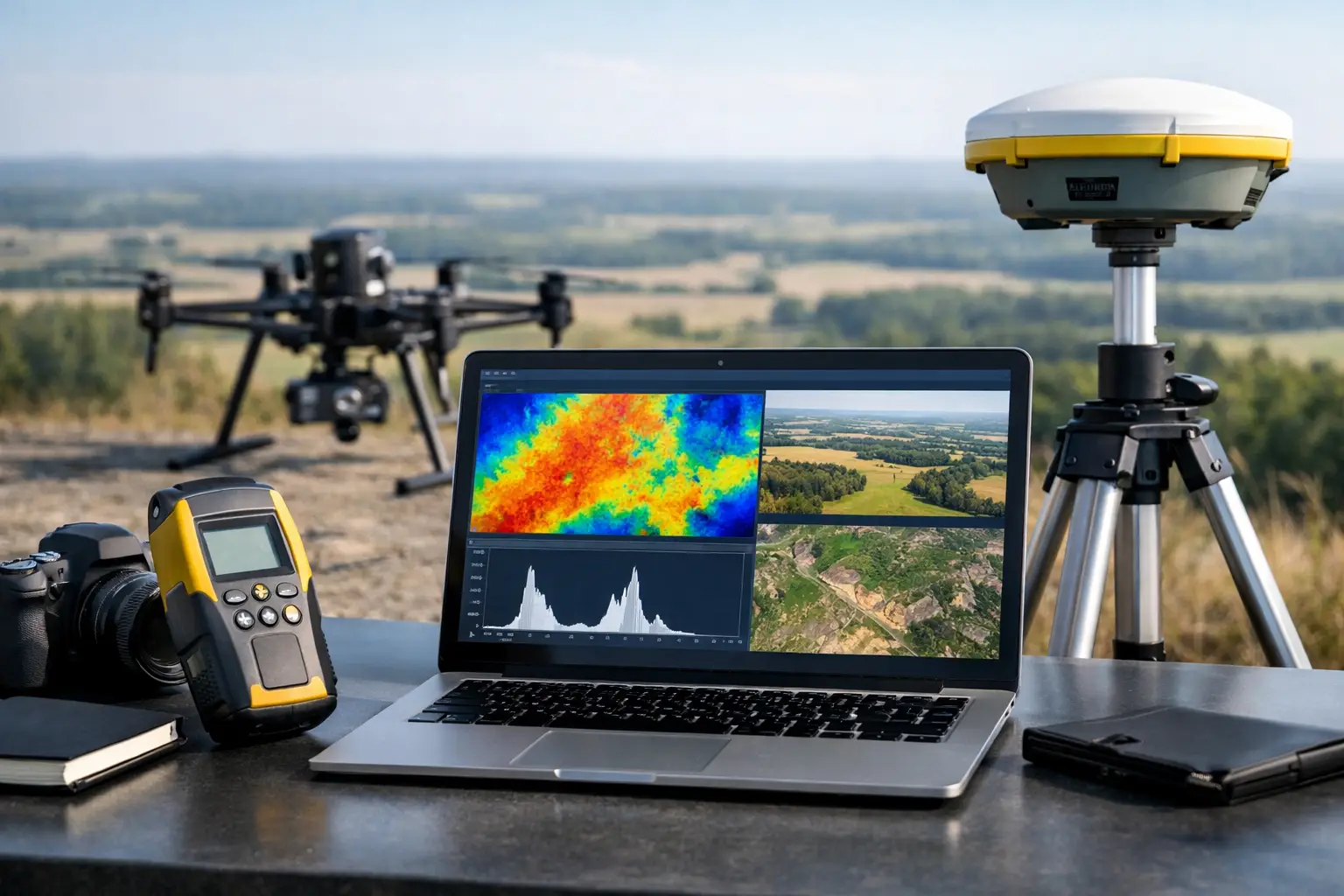

A geophysical survey is only valuable when its outputs can survive technical review, procurement scrutiny, and field validation. That is the real purpose of a guide to interpreted geospatial deliverables: to clarify what buyers should expect after data acquisition, processing, QA/QC, and expert interpretation are complete.
For enterprise and government projects, raw point clouds, magnetic profiles, or orthomosaics are rarely enough. Project owners need deliverables that translate multi-sensor measurements into mapped features, ranked targets, engineering constraints, and defensible recommendations. The distinction matters because procurement decisions, drilling programs, routing plans, groundwater investigations, and asset inspections are rarely based on sensor data alone. They are based on interpreted evidence with traceable methods behind it.
What interpreted geospatial deliverables actually include
Interpreted geospatial deliverables are not just processed files in a folder. They are structured outputs that combine calibrated sensor data, documented processing workflows, geoscience interpretation, and decision-oriented reporting. In practice, that usually means a package containing spatial datasets, technical maps, target layers, anomaly classifications, metadata, QA/QC records, and a narrative report that explains what the data indicates and where uncertainty remains.
The exact content depends on the sensing mode and sector. A mining client may require interpreted magnetic lineaments, structural trends, lithologic boundaries, and ranked drill targets. A water resources team may need depth-to-basement estimates, hydrogeologic controls, drainage characterization, and groundwater prospectivity zones. An infrastructure planner may care more about terrain models, corridor constraints, utility conflicts, and surface change indicators.
The difference between processed and interpreted output is straightforward. Processed output tells you what the sensor recorded after correction and standardization. Interpreted output tells you what that signal most likely means in the context of geology, hydrology, engineering, or asset condition.
A guide to interpreted geospatial deliverables by project type
Different projects require different deliverable architectures. Buyers often make the mistake of asking for every possible output, then discovering that half of the package does not support the decision at hand. A better approach is to define deliverables against the operational question.
Mining and mineral exploration
For exploration programs, interpreted deliverables typically center on structural mapping, alteration indicators, magnetic domain analysis, radiometric signatures, conductive trends, and prospectivity ranking. The strongest packages do more than identify anomalies. They relate anomalies to mapped geology, known mineral systems, access constraints, and drill program logic.
A serious exploration deliverable should also state the basis of ranking. If targets are classified as high, medium, or low priority, the criteria should be visible. That may include amplitude, geometry, coincidence across sensors, structural context, and distance from known controls. Without that logic, target maps can look polished but remain difficult to defend in budget or investment discussions.
Groundwater and hydrogeology
Hydrogeologic interpretation requires more restraint. Electromagnetic response, lineament analysis, topographic control, and surficial mapping can indicate groundwater potential, but they do not guarantee yield. Strong interpreted deliverables in this area distinguish between proxy evidence and confirmed conditions.
That means the report should show how conductivity patterns, geomorphic context, drainage behavior, and structural controls support a groundwater model. It should also identify where borehole or field verification is required. Buyers should be cautious of outputs that present groundwater targets with unwarranted certainty. In this domain, the best interpretation is calibrated, explicit, and realistic about subsurface ambiguity.
Infrastructure, utilities, and corridor planning
For infrastructure projects, interpreted deliverables need to bridge geospatial intelligence and engineering practicality. A terrain product alone will not answer route feasibility. Decision-grade outputs usually integrate elevation models, slope constraints, drainage pathways, utility indications, access conditions, and localized hazard zones.
Where subsurface utility detection or confined-space inspection is involved, interpretation should also support action. That may mean classifying probable utility alignments, flagging conflict areas, identifying deformation patterns, or prioritizing inspection findings by operational risk. A map that only marks features is less useful than one that organizes them into categories relevant to design, maintenance, or permitting.
The technical components that make deliverables defensible
A polished map is not the same as a defensible deliverable. Technical buyers should expect a complete chain of evidence from acquisition through interpretation. That chain usually starts with sensor calibration, flight planning, control, and environmental condition logs. It continues through processing parameters, filtering choices, coordinate reference systems, and accuracy checks.
Interpretation sits on top of that foundation. If the foundation is weak, the interpretation will be challenged. For this reason, high-value deliverables should include metadata, processing notes, version control, and QA/QC records that are fully auditable. This is especially relevant where survey outputs may be reviewed by consultants, regulators, financiers, or downstream engineering teams.
Cross-validation also matters. An interpreted magnetic feature gains credibility when it aligns with topographic expression, mapped structure, radiometric contrast, or field observations. A suspected groundwater zone is stronger when electromagnetic behavior is consistent with geomorphology and known hydrostratigraphy. Multi-sensor agreement does not eliminate uncertainty, but it materially improves confidence.
What buyers should ask for in a guide to interpreted geospatial deliverables
The most effective scope documents do not ask for “data and report” as a generic line item. They specify the intended decision use, the required map scales, the expected interpretation layers, the file formats, and the QA/QC evidence needed for acceptance.
A buyer should ask who performed the interpretation and under what methodological framework. That matters because advanced processing can be automated, but interpretation quality still depends on domain expertise. Geophysics, geology, hydrology, and engineering each bring different assumptions. On complex projects, a deliverable is stronger when those disciplines are integrated rather than treated as separate workstreams.
It is also worth defining the difference between preliminary and final outputs. Early-look products are useful for operational steering, especially on phased surveys, but they should not be confused with final interpreted deliverables. Final packages should reflect completed corrections, cross-validation, and internal review.
File structure deserves more attention than it usually gets. Enterprise clients often need GIS-ready layers, CAD-compatible exports, georeferenced rasters, high-resolution figures, and executive reporting in parallel. If those requirements are not defined early, the result can be technically sound but operationally inconvenient.
Common failures in interpreted deliverables
The most common failure is overproduction of raw or semi-processed files with too little interpretation. This shifts analytical burden back to the client and weakens the commercial value of the survey. Another failure is the opposite: an attractive report with conclusions that are not traceable to the data or methodology.
A third problem is poor alignment with the decision horizon. Exploration managers may need ranked targets for near-term drill planning, while executive sponsors may need a portfolio-level screening view. Utilities may need centimeter-level feature confidence, while regional planning teams may only need corridor suitability classes. If deliverables are not matched to the decision level, even accurate work can miss the mark.
There is also a recurring issue with unqualified certainty. Interpreted geospatial products should identify confidence levels, assumptions, and verification needs. Technical maturity is shown by disciplined language, not exaggerated claims.
How decision-grade deliverables create value
The commercial case for interpreted deliverables is simple. They compress time between acquisition and action. Instead of handing internal teams a large technical dataset to sort through, the service provider delivers structured intelligence that can move directly into targeting, planning, engineering review, or risk management.
This matters most in environments where project windows are narrow, logistics are demanding, and field access is expensive. In those conditions, fast mobilization only solves part of the problem. The full value comes when survey outputs arrive in a form that supports immediate technical and executive use. That is where companies such as Air Solutions differentiate - not by producing more files, but by producing calibrated, traceable, and sector-specific interpretation packages that stand up under review.
For procurement teams, the key test is not whether a vendor can collect data. Many can. The real test is whether the final deliverable is decision-grade, auditable, and aligned with the operational question that justified the survey in the first place.
The right interpreted deliverable does not try to impress with volume. It reduces uncertainty to the point where the next move becomes clearer, faster, and easier to defend.