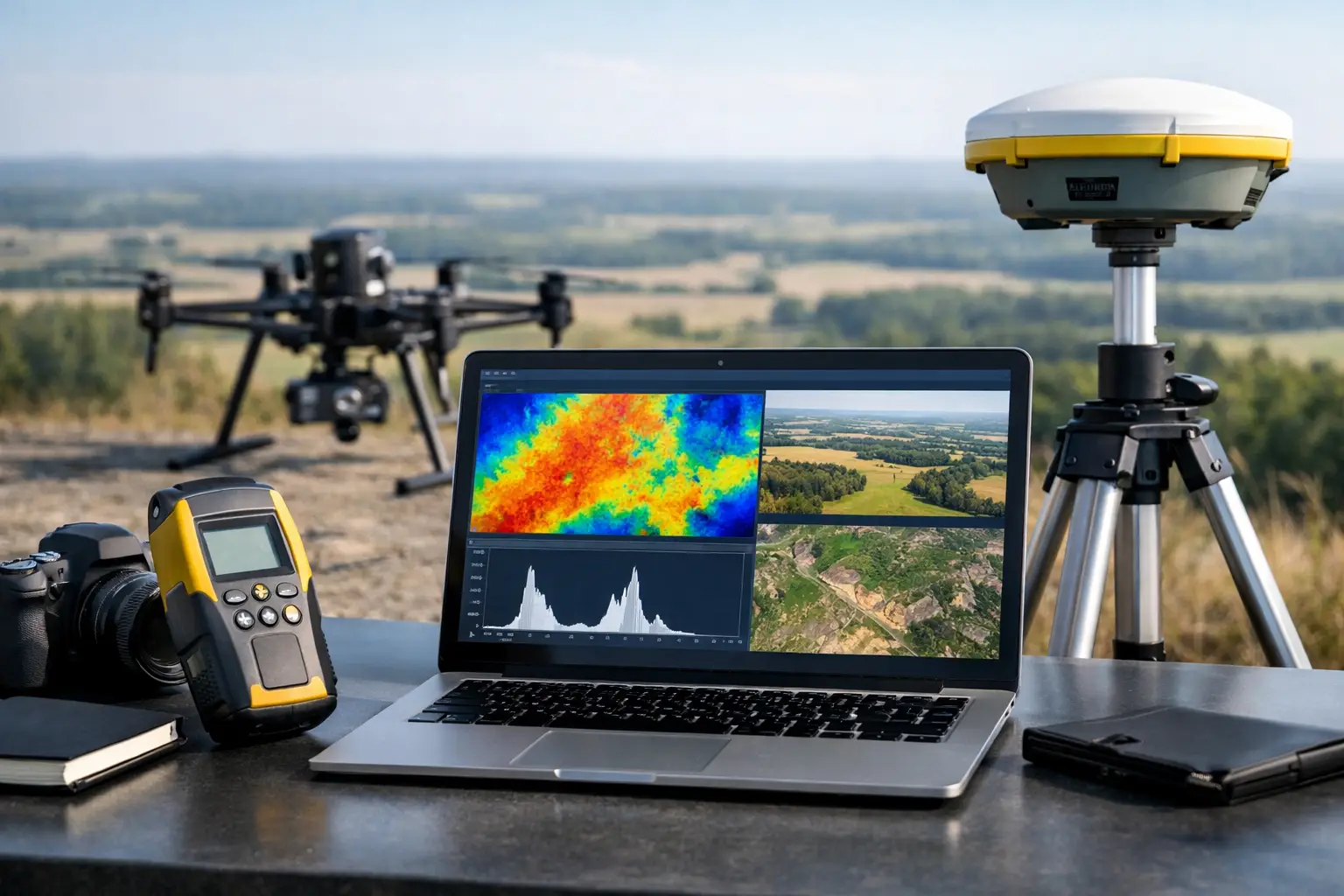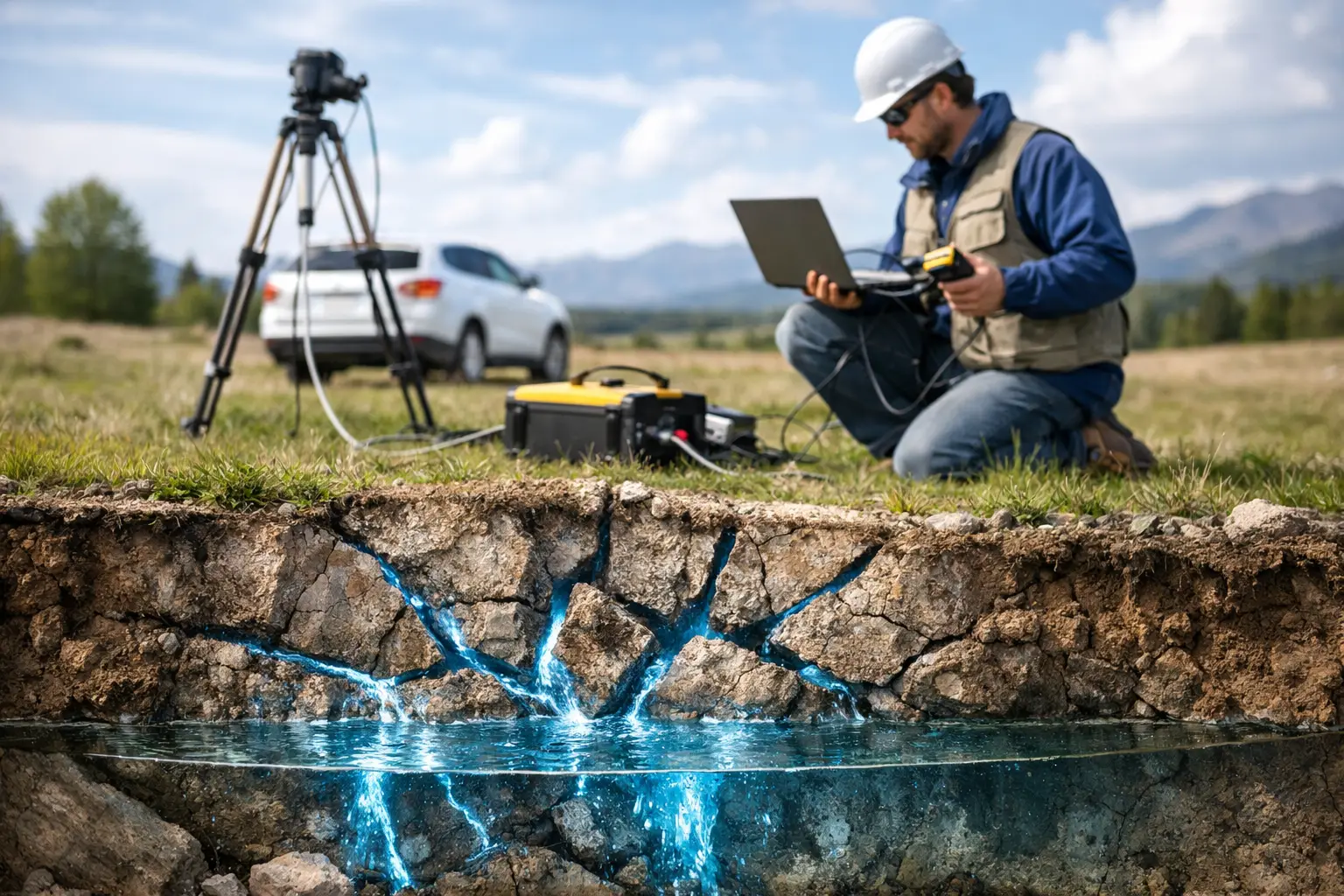
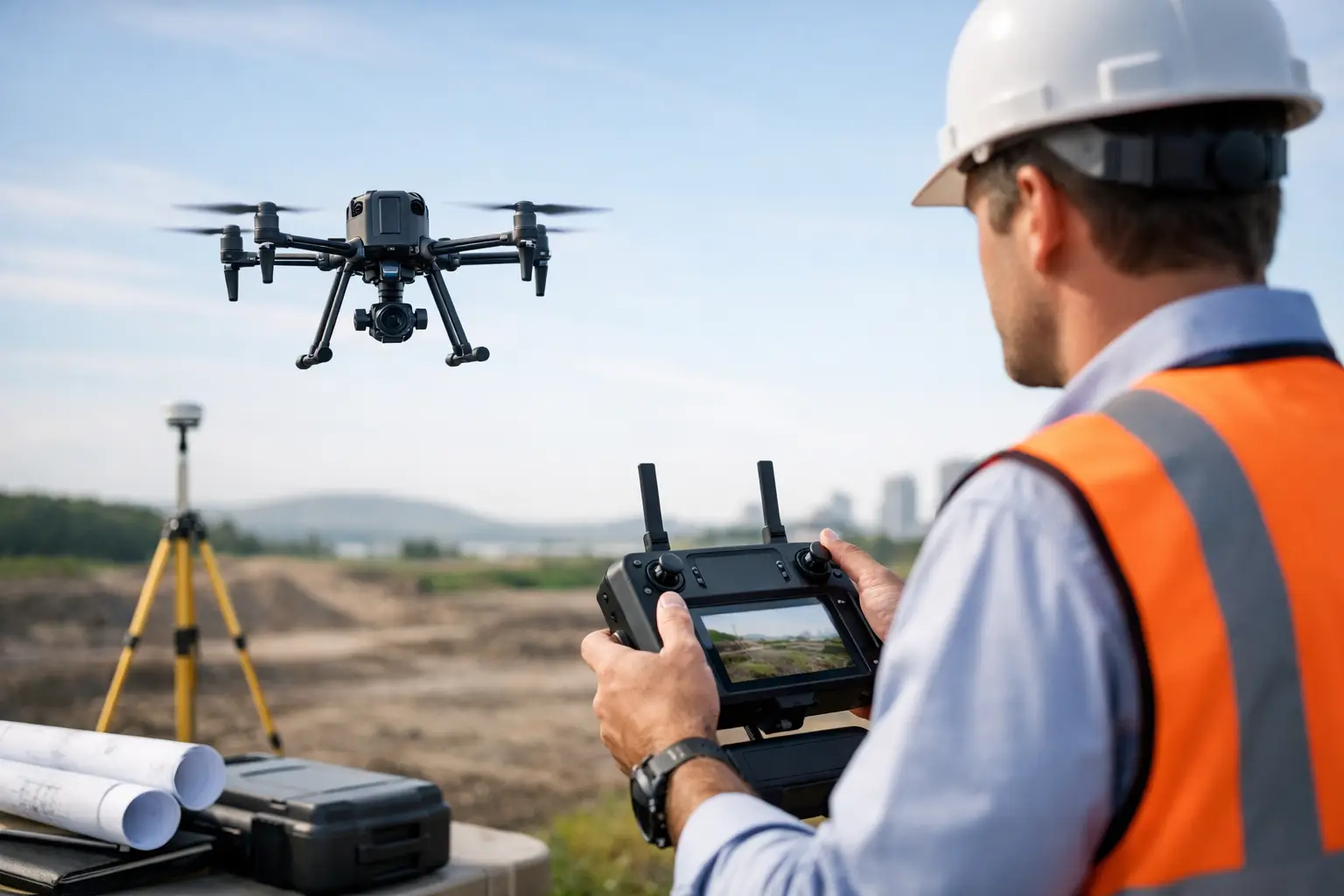
Procurement failures in drone surveying rarely start in the air. They start in the scope document, where vague requirements lead to the wrong sensor stack, weak QA/QC, and deliverables that cannot support engineering, exploration, or regulatory decisions. A disciplined drone survey procurement guide helps buyers avoid that trap by framing the purchase around decision-grade outputs, not flight hours or platform type.
For institutional and enterprise teams, this is not a commodity buy. A mining program, utility corridor assessment, groundwater investigation, or infrastructure inspection has technical dependencies that must be reflected in procurement language from the start. The right vendor is not simply the lowest-cost operator with a drone. It is the contractor that can mobilize in the required environment, collect calibrated data with traceable controls, and deliver interpreted products aligned to the project decision.
What a drone survey procurement guide should actually cover
Most procurement packages overemphasize hardware and under-specify outcomes. That creates room for proposals that look comparable on price but are not comparable in technical value. If your tender asks for a LiDAR drone survey, for example, that is only a partial requirement. The real question is whether the vendor can achieve the density, accuracy, classification quality, control methodology, and reporting standard needed by downstream designers, geologists, or planners.
A credible procurement framework should define five things clearly: the decision the data will support, the physical environment, the sensing modality, the required data quality, and the format of final deliverables. If any of these remain undefined, vendors will fill the gap with assumptions. Those assumptions often become change orders, schedule drift, or unusable outputs.
This matters even more in harsh operating environments. Desert terrain, magnetic interference, high temperatures, remote logistics, and access constraints can materially affect mission design. Procurement teams should test whether bidders are pricing a generic drone service or an engineered survey operation.
Start with the decision, not the aircraft
The fastest way to improve procurement quality is to anchor the scope in the business or technical decision the survey must inform. If the project team needs to identify structural lineaments for exploration targeting, the procurement package should reflect geophysical sensitivity, line spacing logic, and interpretive outputs. If the purpose is volumetrics for earthworks control, then repeatability, surface model accuracy, and cut-fill compatibility matter more than broad area coverage alone.
This distinction sounds obvious, but it is often missed. Buyers request orthomosaics when they need engineering surfaces. They request raw geophysical readings when they need interpreted anomaly maps. They request a drone inspection when they actually need a fully auditable defect register with positional traceability and asset tagging.
When procurement begins with the decision, vendor evaluation becomes more precise. You can ask whether the bidder has delivered the same type of output under comparable constraints. That is far more useful than asking how many aircraft are in the fleet.
Define the survey environment and operational constraints
A strong drone survey procurement guide also forces an honest description of the field environment. Terrain relief, ground control access, airspace restrictions, security protocols, and temperature extremes are not operational footnotes. They affect mission architecture, sensor performance, and achievable schedule.
In Saudi Arabia and across the Gulf, this point is practical rather than theoretical. High heat can influence battery management and sortie planning. Remote mobilization affects spares strategy and field redundancy. Industrial sites may impose permit controls, electromagnetic noise, and workfront coordination requirements. If these factors are left out of the procurement package, pricing will be distorted and proposals will be difficult to compare.
Buyers should ask bidders to state operating assumptions explicitly. How will they manage calibration checks in the field? What is the contingency for wind, dust, or restricted access windows? How will they maintain data continuity if a sensor payload requires replacement? Serious contractors can answer these questions with process detail, not general assurances.
Match the sensor to the problem
Sensor selection is where many tenders become either too generic or too prescriptive. The goal is not to dictate a platform unless there is a justified standard. The goal is to define the performance requirement and let qualified bidders show how they will meet it.
For terrain and infrastructure mapping, photogrammetry may be sufficient if texture, overlap, and control conditions are favorable. For vegetation penetration, corridor modeling, or higher-fidelity terrain extraction, LiDAR may be the better fit. For subsurface investigation, aeromagnetic, electromagnetic, radiometric, or hyperspectral methods may be required, often with integrated interpretation rather than standalone datasets.
This is where procurement teams should be careful. A lower-cost optical survey can become expensive if it fails to capture the data needed beneath vegetation, across low-texture surfaces, or in feature-poor terrain. By the same logic, specifying an advanced sensor without a clear use case can inflate cost without improving the decision. Good procurement language asks vendors to justify sensor choice against the project objective, expected resolution, and environmental constraints.
Make QA/QC a procurement requirement, not a vendor promise
If there is one section that separates decision-grade procurement from basic aerial services, it is QA/QC. Many proposals claim accuracy. Fewer explain how accuracy is established, tested, cross-validated, and reported.
Your scope should require a documented QA/QC workflow covering sensor calibration, control acquisition, line checks where applicable, data completeness verification, processing logs, anomaly handling, and final acceptance criteria. For geophysical and multisensor work, ask how datasets are synchronized, corrected, and fused. For mapping products, ask how absolute and relative accuracy will be verified. For inspections, ask how observations will be georeferenced, classified, and made auditable.
This is not administrative overhead. It is the difference between data that can stand up in technical review and data that becomes a visual reference only. Enterprise buyers should also require clear metadata and version control. If a project later feeds reserve estimates, engineering design, compliance reporting, or capital planning, traceability becomes essential.
Evaluate deliverables, not just field acquisition
A common procurement mistake is awarding on mobilization speed or acquisition price while treating deliverables as a secondary matter. In practice, the deliverable package is what the organization uses, circulates, defends, and archives.
That package should be specified in detail. Will the vendor provide raw data, processed data, interpreted outputs, GIS-ready layers, engineering surfaces, anomaly maps, defect registers, or executive reporting? In what coordinate system, file structure, and naming convention? What level of technical narrative is required? Who signs off on the interpretation?
For many industrial buyers, raw data alone has limited value. Internal teams do not always have the time, software environment, or specialist capability to process and interpret it. A Data-as-a-Service model can therefore be more commercially rational than a low-cost raw-data contract, provided the procurement documents define acceptance criteria for those interpreted outputs.
How to compare bidders in a drone survey procurement guide
Bid comparison should balance technical compliance, execution maturity, and commercial structure. Lowest price is only meaningful after you have normalized scope assumptions and data quality standards.
A technically grounded scorecard usually tests four areas. First, domain relevance: has the bidder done comparable work in mining, utilities, water resources, infrastructure, or industrial inspection? Second, operational readiness: can they mobilize quickly, manage permits, and execute safely in the required environment? Third, data integrity: is the QA/QC system documented, repeatable, and fully auditable? Fourth, deliverable fitness: will the outputs support the exact decision pathway your project requires?
There is always a trade-off. A highly specialized provider may price above a general drone contractor, but that premium can be justified if it reduces resurvey risk, compresses schedule, and delivers interpreted products that remove burden from internal teams. On complex projects, the cheapest field day rate often leads to the highest total cost.
Contract terms that deserve more attention
Procurement teams should also address ownership, confidentiality, rework triggers, and acceptance mechanisms with more precision than is typical. Multi-sensor surveys can generate commercially sensitive geospatial intelligence. The contract should define who owns raw data, processed data, and derivative interpretations, and whether the vendor may reuse anonymized operational learnings.
Rework clauses matter as well. If acceptance thresholds are not met, what qualifies as corrective action, and on what timeline? If access restrictions imposed by the client affect line completion or control placement, how will that be handled commercially? Clear language reduces dispute risk and keeps project governance intact.
Where national-scale infrastructure or strategic resource projects are involved, buyers may also require evidence of information security controls, audit trails, and reporting discipline aligned with internal governance frameworks. That should be requested during procurement, not after award.
The strongest procurement outcome is a defensible one
A good drone survey buy is not the one with the most impressive aircraft specification sheet. It is the one that produces calibrated, traceable, and decision-fit intelligence under real operating conditions. That requires procurement teams to write scopes with technical intent, evaluate vendors on execution maturity, and insist on deliverables that can withstand internal review.
For buyers managing high-value assets, exploration budgets, or public infrastructure timelines, the standard should be simple: procure the survey the project needs to make the next decision with confidence. Everything else is noise.
The most useful question to carry into your next tender is not, “Who can fly this site?” It is, “Who can deliver data we can defend?”